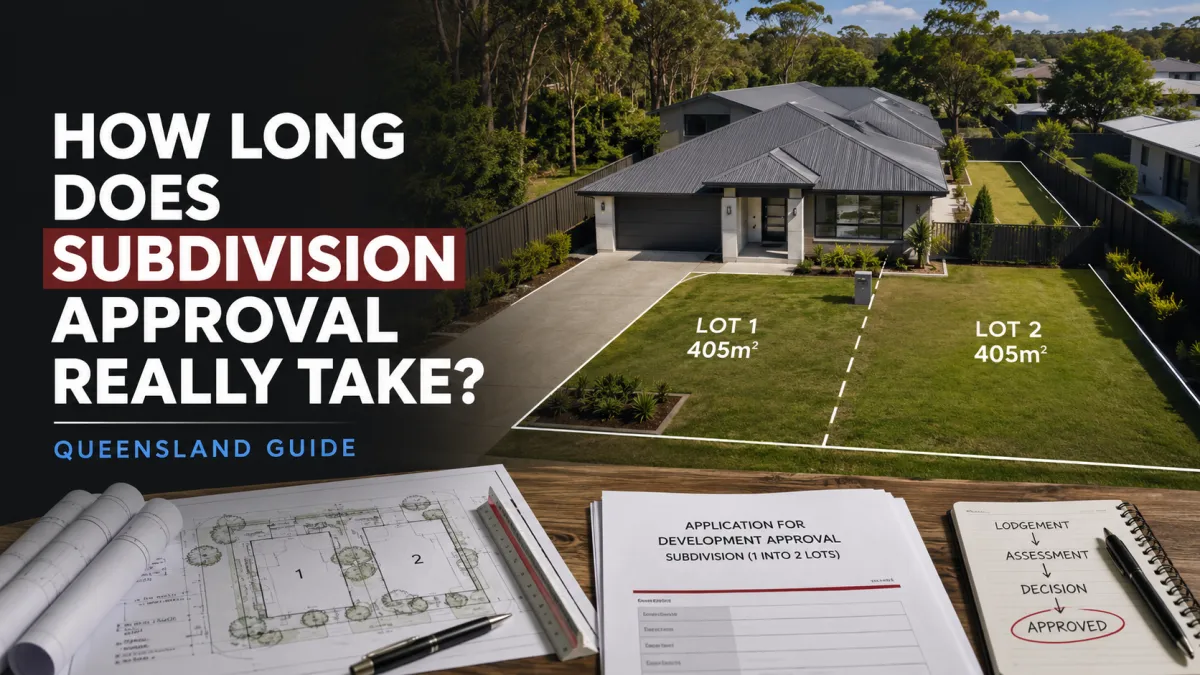
How Long Does It Really Take to Get Subdivision Approval?
How Long Does It Really Take to Get Subdivision Approval in Queensland?
For a straightforward, well-prepared subdivision application in Queensland, a realistic timeframe is generally one to three months from lodgement to approval.
However, that is not a guaranteed timeframe. A subdivision involving planning non-compliance, flooding, difficult levels, infrastructure constraints or State referral can take considerably longer.
The honest answer is that the approval timeframe depends as much on the property and application quality as it does on the council assessing it.
What does “subdivision approval” mean?
In Queensland, subdividing land is generally called reconfiguring a lot. Where assessable development is proposed, a development application must be lodged with the relevant council.
For this article, the subdivision timeframe starts when the application is properly lodged and ends when council issues its development approval.
It does not include:
satisfying the approval conditions;
completing civil or infrastructure works;
obtaining operational works approvals;
plan sealing; or
registering the survey plan with Titles Queensland.
Receiving subdivision approval does not mean the new lots and titles immediately exist. Plan sealing and registration are separate stages that occur after the relevant approval conditions have been satisfied. Brisbane City Council explains this distinction in its subdivision guidance.
How long does a straightforward subdivision application take?
Based on our experience, a straightforward Queensland subdivision can often be approved within one to three months.
Brisbane City Council’s general public guidance indicates that a code-assessable subdivision aligning with Brisbane City Plan may take approximately three to four months. It also warns that applications may take longer when impact assessment or further information is required.
Actual timeframes vary between councils and projects. A compliant one-into-two-lot subdivision on a well-serviced, unconstrained property is very different from subdividing land affected by flooding, steep slopes or infrastructure limitations.
Why aren’t council timeframes guaranteed?
Queensland’s development assessment process contains formal stages and statutory timeframes, but these should not be confused with a guaranteed calendar completion date.
The process may involve:
Application and confirmation
Referral to a State agency
An information request
Public notification, where required
Council’s decision
The Queensland Development Assessment Rules govern how applications are lodged, assessed and decided.
The assessment clock can pause while council waits for the applicant to respond to an information request. For an impact-assessable application, the decision stage does not commence until the required public notification process has been completed.
Extensions, applicant-requested pauses, referral requirements and changes to the proposal can also extend the real elapsed timeframe.
What commonly delays subdivision approval?
1. Council information requests
If council considers that it does not have enough information to assess the application, it may issue an information request.
The application cannot meaningfully progress until the requested information is prepared and submitted. This can require further input from engineers, surveyors, planners or other specialists.
2. Incomplete or poor-quality reports
Submitting an application quickly does not necessarily produce a quick approval.
Missing information, inconsistent plans or reports that fail to address the relevant planning requirements increase the likelihood of further questions and delays.
A complete, coordinated application gives council more confidence to proceed to a decision.
3. Infrastructure and servicing constraints
Sewer, stormwater, water supply and vehicle access can materially affect whether a subdivision is practical.
A sewer main shown near a property does not automatically mean that each proposed lot can be easily serviced. The property’s levels, connection location, capacity and the need for easements or infrastructure extensions must also be considered.
4. Choosing a difficult site
Some delays begin before the application is lodged—or even before the property is purchased.
Common constraints include:
land sloping toward the rear;
flooding or overland flow;
no practical sewer connection near the site;
difficult stormwater discharge;
environmental or hazard overlays; and
proposed lots that do not meet council’s minimum size, frontage or design requirements.
A one-into-two-lot subdivision may sound simple, but that does not mean every property can be divided easily.
5. Referral agency assessment
Some applications must be referred to a State agency because of matters such as State-controlled roads, waterways or other State interests.
Referral introduces another assessment body, additional requirements and potentially further information requests.
Case study: Brisbane subdivision approved without an information request
ZoiQ recently assisted with a straightforward one-into-two-lot subdivision in the Brisbane City Council area.
The application was approved in approximately four to eight weeks, without council issuing an information request.
The result was not simply good luck. Several factors helped the application move efficiently:
a suitable site was selected;
the planning issues were identified early;
the required consultant reports were completed before lodgement;
the plans and reports were coordinated; and
communication with council was handled proactively.
The lesson is simple: the fastest subdivision application is usually the one that has been properly investigated before it reaches council.
How can owners reduce the risk of delays?
Before purchasing, designing or lodging a subdivision application:
commission a preliminary town-planning review;
confirm the applicable minimum lot size and frontage requirements;
check whether every proposed lot will comply;
investigate sewer and stormwater access;
review flooding, slope and planning overlays;
identify State referral triggers;
confirm which consultants and reports will be required; and
resolve obvious design and servicing problems before lodgement.
These investigations cannot guarantee a particular approval date, but they can identify the issues most likely to delay, or prevent, the subdivision.
So, how long should you allow?
For a suitable site and a well-prepared application, allow approximately one to three months for subdivision approval in Queensland.
For constrained, non-compliant, impact-assessable or State-referred proposals, allow considerably longer.
Most importantly, do not base a purchase, finance commitment or construction program on the assumption that council’s statutory timeframe is a guaranteed approval date.
If you are considering subdividing a property, ZoiQ can undertake a preliminary site review before you commit to the design or application. We will identify the likely approval pathway, key site constraints and information required to give the application the best chance of progressing efficiently.
Request a complimentary preliminary subdivision site review with ZoiQ.